HUDLESTONS AND COTHERSTONE
This article emanated from Millom Castle, the Hudlestons and the English Civil Wars project. Ferdinando Hudleston (1577-1646) Ferdinando Hudleston became the thirteenth lord of Millom on the death of his father, William, in 1628. By 1600 he had married his second wife, Jane Grey, daughter of Sir Ralph Grey of Chillingham, Northumberland. The couple decided to live at another Hudleston property, Thwaites Hall, west of Cotherstone, four miles from Barnard Castle in the county of Durham (but at that time it was in Yorkshire). The estates at Cotherstone and Hunderthwaite were held as one manor by the Hudlestons, having been in the Hudleston family since the reign of Henry VII and remained in their possession until 1741. Thwaites Hall still stands but has been converted into three holiday cottages. Teesdale Mercury There are three articles in the Teesdale Mercury from the 19th and 20th centuries that refer to Ferdinando Hudleston. A major problem is that the author(s) are discussing one Ferdinando Hudleston throughout the period, whereas Ferdinando had died in 1646 and his son, William became the lord of Millom and when he died in 1669, his son, another Ferdinando, became lord of Millom. The first, entitled Thwaites Hall, Cotherstone, was published on 10th May 1882 and it is worth noting that this is a rework of the same story told in the same newspaper on 6th October, 1858. It tells us that whilst Ferdinando had a mansion in Cumberland, the family also owned the manors of Cotherstone and Hunderthwaite, and he and his family lived principally at Thwaites Hall. The writer says Ferdinando supported both the King and Catholicism. When he learnt that a Parliamentary trooper named Horne was recruiting around the district, he wrote to his brother, a priest in London, to seek his opinion as to how he should act. His brother advised him to raise troops and proceed to York to support the Royalists there. This he did, and the troops left on 30th June, 1644, but on arriving near York, after three days travelling, they were informed that the Royalists had been routed at Marston Moor. Some of the party believed the Royal cause was useless and returned home whilst others carried on to York to support the King. The article states that 'Mr' Hudleston rewarded those locals who had remained faithful, with gifts and one in particular, a servant called Langstaff, was given a farm. The article says that during the Commonwealth (1649-1660) 'Mr' Hudleston took asylum in Holland, having had his estates confiscated, and a receiver of the rents was appointed. Shortly after the Restoration (1660) he returned, and had his possessions given up to him. There are no further references (at the moment - that is not to say something might turn up in the future) regarding asylum in Holland. Of course, we know the Hudleston estates were taken away during the Civil Wars and returned when King Charles II was on the throne. This is further evidenced by a document found in Carlisle Archives under the Senhouse Family records. The document is dated 1664 and shows the potential rateable value of property in their Yorkshire estate.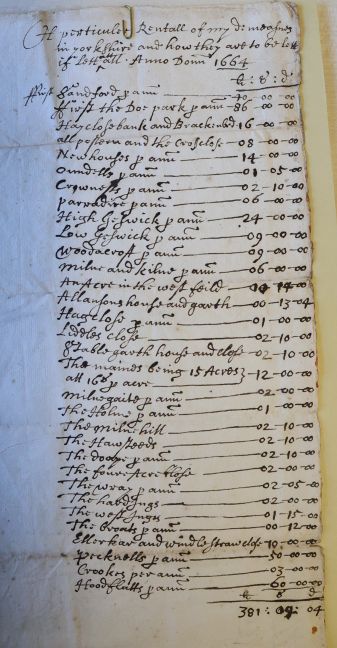
The article says, as a result of their support for the King, the Hudlestons were exempted from the penalties exacted to other Catholics for many years. It seems likely the origins of this assertion may be connected with Father John Huddleston of Hutton John who was indeed supported by the Royal Family. It is unlikely, however, it applied to all of the Hudleston family.
The second article appeared in the Teesdale Mercury, Wednesday May 17, 1882, and is in response to the earlier one. A local says his ancestor was one of those troopers who returned home and stressed that he and the others remained loyal to the King but believed the cause was wrecked at Marston Moor. Another reader said his family still owned the Andrea Ferara broadsword used by his ancestor in the 17th Century. The author continues:
He says,
The Mr Ferdinando Huddlestone of whom we spoke last week, attempted to revive the old feudal customs that were fast expiring in his day. Among others he expected his tenantry to muster with their pack-horses - there were no carts then, nor would the roads have admitted of them, - when he moved from Thwaites Hall to Millom Castle (his residence in Cumberland) and back again, and transport his household effects at their own expense and his wrath was great when they stubbornly refused.
Various assaults by the same Ferdinando Hudleston are found in the Romaldkirk Court Rolls:
October 18, 1677. - We find Ferdinando Huddlestone, Esquire, to make an assault upon John Hugginson, and therefore we do amerce him 20s. Also upon William Hutchinton he made an assault, amerced 20s. Also he made an assault upon Christopher Longstaffe, amerced 20s. Also we find Ferdinando Huddlestone, Esq., to make an assault upon Henry Walker, and we do amerce him in 3s 4d. Also we find Henry Walker to make an affray upon Ferdinando Huddlestone, Esq., and we do amerce him 3s 4d. Also we find Ferdinando Huddlestone, Esq., to make an assault upon Charles Harker, and we do amerce him 20s.
This Ferdinando Hudleston must be the son of Colonel Sir William Huddleston who took over the lordship of Millom in 1668 when his father died and was lord until 1686/7.
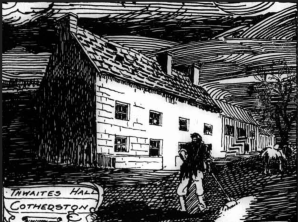
The third and final article was printed in the Teesdale Mercury, on the 8th April 1936. It is written by F.E. Coates and entitled Thwaites Hall, part of a series of articles about Cotherstone. The article includes the following pen and ink drawing and a description: